The driveway looks sun-bleached, and loose grit comes off on your slippers every time you walk to the car.
Sealcoating in Honolulu is the job everybody means to get to right after they clean out the garage. We do asphalt sealcoating on driveways and small lots from town out toward the west side, and we're fussy about it in a way plenty of sealcoating companies are not.
One thing you will never catch us doing is dragging sealer across a dusty surface or over open cracks, because that skin lifts in sheets by the second wet season and all you bought was a coat of paint. Size, access, how chewed up the surface has gotten and how much crack work has to happen first all change what the job takes.
Below: how the work is really done, what it costs, when driveway sealing is the wrong fix, and the questions people ask first. Call (808) 808-9481 and we'll come look at it.
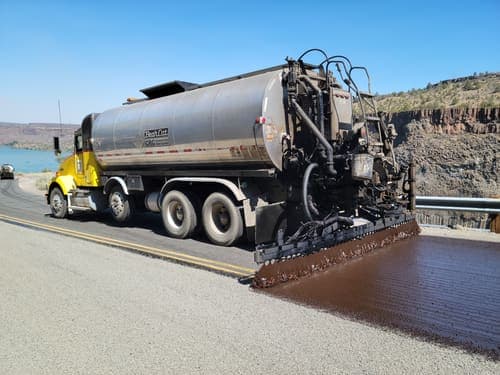
Chip Seal Driveway
A chip seal driveway is a different build from sealcoating, so don't let anyone sell you one as the other. We spray hot asphalt binder onto the surface, spread crushed stone into it while it's still tacky, then roll the chips down hard so the binder locks around them. You end up with a rough, grippy driving surface instead of a smooth black one, which is why it suits long sloped drives that get greasy underfoot in the wet months.
Done poorly, it throws rock for months. Skimp on binder or roll after the binder has skinned over and your tires will fire chips into the grass and the neighbor's paint.
It's one piece of the Honolulu Asphalt Paving work we take on, and it isn't always right. Length, truck access, grade and how much stone the surface soaks up all move what asphalt sealing or chip work runs you.
What the job involves
Sealcoating is mostly prep, and the black stuff going down is the easy part. We blow and wire brush the surface back to clean asphalt, then hit the oil drips where you park with degreaser and prime them, because sealer will not bond to a patch with motor oil soaked into it. Plenty of sealcoating companies skip that step and you see it a year later as a shiny bare halo.
Cracks get filled first, anything wider than about a quarter inch. Grass creeping over the edge gets cut back so the coating carries right out to the shoulder instead of stopping short. Then two coats, squeegeed tight along the edges and sprayed through the middle, with sand in the mix so a wet surface still has grip. Size, truck access and how chewed up the surface has got are what move an asphalt sealing job.
What it costs
What it costs comes down to four things: how much surface there is, what condition it's already in, how much of the edge work has to be cut in by hand, and whether we can get the truck anywhere near it. A flat, open pad off a straight approach prices differently than a sloped one behind a narrow gate, where every pail gets carried in on foot.
Condition moves it more than size does. If cracks need filling and oil-soaked patches need priming first, that's prep hours, and prep is where the cheaper quote goes quiet. Two coats cost more than one and earn it on a driveway sealing job that takes daily traffic.
Call me at (808) 808-9481 with rough dimensions and I can give you a real figure for asphalt sealcoating on your own property.
Timing plays in too. Wet season means watching the sky, and sealer laid ahead of rain is money spent twice.
When sealcoating is the wrong fix
Sealcoating is the wrong fix in three situations I run into most weeks, and I would rather say so now than after you've paid me. If the surface gives under your heel and the cracking has gone to a spiderweb, the base underneath is finished, and asphalt sealing over it is lipstick on a pig. That's a Driveway Paving job, or Asphalt Resurfacing where the sub-base is still sound.
If the gaps are wider than about a quarter inch, sealer sinks in and leaves a dark stripe that splits open again fast, so Crack Filling has to happen first. And if your apron has heaved above the garage slab, seal coating only makes the bump shinier. Asphalt Milling shaves the high spots off. A lot with worn-out stalls needs Parking Lot Striping, not a fresh black coat.
Why choose us for this
You've got a driveway gone gray and grabby, and what you'd like is to handle it once and not think about it again for a few years. That's what most people ringing a paving company about sealcoating are really after.
So the figure I give you standing on your own driveway is the figure on the invoice, unless you add work to it. Your job gets finished before my crew picks up the next one. Nobody pushes you to sign anything that afternoon.
I don't thin the material to make a cheaper number work, either. Thin asphalt sealcoating looks sharp for a month, then the grit comes back through. Size, how much cracking is hiding under it, and how close I can get the truck are what move it.
Having me come look costs nothing.
Frequently asked questions
How often does my driveway need sealcoating?
Every three to four years for most homes here. Sun does more of the damage than tires do, and once the surface turns gray and porous, rain soaks straight into the binder instead of running off it. If your seal coat still beads water and looks dark after a downpour, you can leave it another year.
Will the sealer get on my concrete or my plants?
We mask the concrete apron, the garage slab edge and any block wall before the first pass, then cut those edges in by hand. Overspray on a light walkway doesn't come off, so hand work at the borders takes longer than spraying would.
Can you do driveway sealing during the wet season?
Yes, we just work around the showers. The surface has to be dry going down and stay dry for hours after, or it washes into the street.
Contact Honolulu Paving Co now
Looking for asphalt paving contractors in Honolulu to sort out a tired driveway? The office number is (808) 808-9481, somebody is there weekdays nine to five, and if we are out on a job leave a message, because every message gets called back.
When I come by, I measure the surface, check how wide the cracks have opened, look at the apron for oil that has to be primed first, and see whether the sealer can be pulled in tight along the garage lip. Size, truck access, how much crack work has to happen before any sealer goes down, and how chalky the surface has got are the things that move a driveway sealing job one way or the other.
We work around the sky. Sealer needs a dry stretch to cure, so if rain is coming we move you instead of chancing it.