One panel sitting an inch proud of the next, and every pair of slippers on the block finds it.
We pour and fix concrete sidewalks all over town, and the call usually starts with somebody stubbing a toe or the mail carrier saying something. An old concrete sidewalk here rarely fails from cold. It fails from tree roots, from rain running underneath where nobody gave the water anywhere to go, and from being poured thin over ground that was never packed. Plenty of concrete sidewalk contractors will just cap the bad panel and go.
We look at what the water is doing first, we tell you straight when a section can stay, and we sweep the walk before the truck rolls out.
Below is how the job actually gets done, what moves the number, when a pour is the wrong answer, and the questions people ask before they book. Ring (808) 808-9481 and I'll come walk it with you.
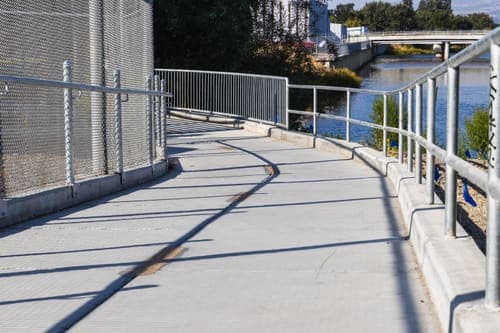
Paved Walkways
Paved walkways are the asphalt cousin of concrete sidewalks: garden paths, courtyard runs between buildings, the stretch from a parking stall to a lobby door. We lay them two inches over a crushed rock base, roll them with a walk behind machine where no truck will fit, and cut a clean edge so the sides don't ravel away in the first heavy rain.
Thin asphalt over bare dirt is where these go wrong. Roots find it, water gets underneath, and after a couple of wet seasons you've got a path shaped like a surfboard. Width, grade and access are what stretch the days on site, since a walkway that has to be fed by wheelbarrow is all hand work.
On the paving side of things, Honolulu Asphalt Paving runs walkways with the same crew that forms and pours the concrete.
ADA Ramps
ADA ramps are the part of a sidewalk job that gets botched most often, and it almost always shows up at the bottom lip. We build ADA compliant curb ramps to the federal spec and pull the slope, landing and flare dimensions for your address before we set a single form.
That usually means cutting the gutter curb back properly instead of feathering fresh concrete over what's there, so runoff still finds the inlet rather than ponding right where somebody in a chair has to stop and wait.
The detectable warning panels, those yellow domed pads, we cast into wet concrete. Glue-down pads stuck to an old concrete sidewalk start lifting at the corners and turn into the exact trip hazard they were meant to prevent.
What moves the number: how much surrounding walk comes out, curb depth, and whether we're forming inches from live traffic.
Concrete Sidewalk Repair
Concrete sidewalk repair is panel work more than patch work. When a slab has heaved, cracked into three pieces or dished enough to hold water for a day, we saw cut the joints full depth, break that panel out, rework the base and pour it back at four inches over crushed rock so it sits flush with its neighbors.
Skim coating over a broken slab is the shortcut that gets sold as sidewalk repair, and it bonds for a few months before it flakes off in sheets and hands you the same toe catcher.
Roots cause most of what we replace. Monkeypod will lift a walk a full inch, so we cut the root and set a barrier before the pour, or the new concrete goes the same way as the old.
We powerwash sidewalk panels once things cure, which also shows whether nearby concrete sidewalks are staining or actually failing. Panel count, access for the saw and how much demolition is involved are what change the number.
Sidewalk Crack Repair
Sidewalk crack repair is the cheap hour that saves you an expensive afternoon two years from now. Hairline stuff we clean out and seal. Anything wider than about a quarter inch gets chased open with a crack saw, blown out with air, then filled with a flexible polyurethane that moves when the slab moves. Skip the routing and you have sealant sitting in a dusty groove, and the first hard rain off the mountains floats it straight back out.
We powerwash sidewalk panels before we fill anything, because filler over grit is just paint with a good attitude.
How much cracking there is, whether a monkeypod root is behind it, and how close we can park the equipment are the things that swing the number. And if an old concrete sidewalk has cracked with a lip you can catch a toe on, filling it solves nothing. That panel comes out.
Gutter Curb
A gutter curb is the curb face and the drainage pan poured as one piece, so water running off the street has a path instead of sheeting across your concrete sidewalks. We set forms to the flow line before anything else, string it and check it over the whole run, then pour on crushed rock and tool the throat so it sheds clean.
Miss that line by a hair and you get a standing puddle that breeds mosquitoes and leaves a dirty gray stain down the curb face within a few months.
What moves the price is the length of the run, how much of the existing curb has to be sawcut and hauled off, whether we are tying into a live drain inlet, and how much room the street gives us to work.
Where the gutter meets a crossing, we form it and the ADA compliant curb ramps together, never one patched onto the other.
Cement Sidewalk Installation
Cement sidewalk installation is mostly won or lost before any concrete shows up on site. We pull the old material out, bring in crushed rock, pack it in lifts, and set the forms to a line and a grade so rain runs off the walk instead of sitting on it. Four inches of concrete over that rock for a foot-traffic run, six where a driveway crosses.
Broom finish, joints cut in, and a slow cure so the top doesn't skin over ahead of the middle and craze.
Pour on loose fill and you'll have panels rocking under your feet by the second wet season. Plenty of concrete sidewalk contractors treat the base as the part nobody sees. Length of the run, truck access, and how much has to leave by wheelbarrow are what move new concrete sidewalks up or down in cost.
Forming A Concrete Sidewalk
Forming a concrete sidewalk is the part nobody notices and the part that decides whether the finished walk looks straight or wanders like a garden hose. We run string lines, drive stakes every couple of feet, and screw the forms tight to them so nothing bows outward when the mud goes in. That's the step rushed concrete sidewalk contractors skip, and you can read the results down half a block: fat spots, thin spots, a wavy edge you can't unsee.
Under the forms goes base rock, tamped flat, then four inches of concrete, six through a driveway apron where a truck crosses. We pitch the run away from the house so rain sheets off instead of sitting against your slab, and we tool the control joints in while it's still green so your concrete sidewalks crack where we told them to.
Length, width, thickness, access for a wheelbarrow and how much old walk comes out all shift the cost to install a concrete walkway.
ADA Curb Ramps And Sidewalks
ADA curb ramps and sidewalks are one job, not two, because a ramp is only as good as the walk and the gutter line it lands in. We build to the ADA spec and pull the slope and landing dimensions for your site before we form anything.
That means saw cutting the existing walk back to a clean joint, wet setting the detectable warning panels into fresh concrete instead of gluing them onto a cured slab, and finishing the bottom so water runs along the flow line rather than sitting in the ramp. Done badly, you get a lip at the gutter, a front wheel catches it, and inside a year the panels are lifting off.
What moves the number here is the count of corners, how much gutter has to come out, and whether building handicap ramp access means closing a traffic lane.
Ramp For Sidewalk
A ramp for sidewalk access at a front door, a shop entry or a side gate is a different animal from a flat pour. We build to the ADA spec and pull the slope and landing dimensions for your address before we form anything, because the run depends on how much rise you're covering between grade and the threshold. Half these calls are about building handicap ramp access so somebody can get a wheelchair to their own door without help.
We saw out the panel, place four inches over crushed rock, six where a tire will track it, and finish it with a stiff broom so it isn't a slide in heavy afternoon rain. Where it meets an old concrete sidewalk we dowel the joint.
Rise, handrails, and how close we can park the truck are what shift the number.
Old Concrete Sidewalk
An old concrete sidewalk usually tells you what it needs before we even pull up. Chalky, pitted surface, aggregate showing through, one panel tilted where a monkeypod root shoved its way underneath.
First thing we do is powerwash sidewalk panels clean. A lot of what looks like ruin is dirt, mildew and rust staining, and a wash settles the argument about how much really has to come out. As concrete sidewalk contractors we'd rather save sound panels than haul them to the dump.
What does come out gets sawcut at the joints so we're not cracking into good work. New pour goes four inches over clean crushed rock, roots trimmed back first or you'll be looking at the same lift again. Volume of demolition, truck access and root work are the things that swing the price on old walks.
What the job involves
Most of the concrete sidewalks we put in start with demolition: saw the old panels, break them out, haul the rubble away, then grade and tamp the ground so the new slab has something firm under it. Forms go in next. We set the pitch so rain sheds toward the street instead of ponding against your wall, then pour four inches over crushed rock, six where a truck crosses.
Broom finish, always, because a slick troweled surface plus a heavy afternoon shower is how people end up on their back. Joints get saw cut. You're walking on it back on after 24 hours.
Where we tie new work into an existing run, we powerwash the sidewalk first so we're matching real color, not grime. Length, width, how much old concrete comes out, and whether the truck can reach the pour all move the number.
What it costs
What it costs to install a concrete walkway comes down to a few things I can read off the site in about ten minutes: length, width, and whether a truck can back near the pour or we're wheeling every barrow down a side gate. Access moves the price more than anything else. So does what's already sitting there.
Breaking out an old concrete sidewalk and hauling the rubble off is real labor, and a run that ties into a gutter curb or needs ADA curb ramps and sidewalks formed at the corner adds forming and finishing time. Heavy afternoon rain can push a pour a day, too, since I won't trowel a slab in a downpour.
Give me the rough dimensions at (808) 808-9481 and I'll price your walk instead of guessing. Patching two sunken panels prices nothing like a full replacement.
When concrete sidewalks are the wrong fix
Sometimes concrete sidewalks are the wrong answer, and I would rather say so at the estimate than after we have set a single form. If your old concrete sidewalk is basically sound and the trouble is a few thin lines and one joint sitting proud, sidewalk crack repair and a bit of grinding solves it in an afternoon, and demo costs you nothing because there is no demo.
If the real problem is the surface feeding that walk, concrete is the slow road. Driveway Paving in asphalt goes down in a day and flexes with the ground instead of splitting at a fixed joint. On tired pavement over a solid base, Asphalt Resurfacing or spot Asphalt Repair does more for you than a poured walk ever will, and Sealcoating keeps the rain out afterward.
Once the mat cures, Parking Lot Striping lines the stalls and the access aisle up with the walk.
Why choose us for this
You've got a stretch of concrete sidewalks out front that's lifted, spalling or holding water after a rain, and what you really want is to hire somebody once and never think about that slab again. Not to babysit anyone. Not to chase phone calls.
We're rarely the low bid among concrete sidewalk contractors on this island, and the reason is the part nobody sees: we saw and remove the full panel, reset the grade over crushed rock, and pour thick instead of skimming a patch across old concrete.
Having us come look and figure it costs you nothing, with no obligation to book.
Frequently asked questions
Can you just fix the bad section, or does the whole thing have to go?
Most concrete sidewalks come out in panels, so we saw the joints and replace only the ones that have cracked through, sunk or lifted at a corner. That's concrete sidewalk repair, and it works when the ground under the slab is still solid. When every panel is spidered and the joints have spread, patching one square just moves the trouble a few feet down the walk.
What changes the cost to install a concrete walkway?
Square footage first, then access. A crew that can back up to the forms works faster than one wheelbarrowing concrete through a side gate. Depth counts too, four inches for foot traffic and six where a vehicle crosses. Breaking out and hauling off an old slab, forming a concrete sidewalk around tree roots or a grade, or tying into ADA ramps all add hours.
How soon can we walk on it?
You're back on after 24 hours. Hold off on hoses, dogs and any powerwash for a few weeks while it cures.
Contact Honolulu Paving Co now
Ring us at (808) 808-9481 and we'll get asphalt paving contractors in Honolulu out to walk the property with you, tape in hand. On that visit I measure the run, see where the water goes, and check the slab edges to work out whether that old concrete sidewalk is lifting off tree roots or just worn thin. That tells us if it's concrete sidewalk repair or a full tear-out, and how many days the crew is parked out front.
Length, truck access and the state the walk has got into are what shift the number. We're reachable weekdays, nine to five, and if the walkway is a genuine trip hazard we'll come out on a weekend. Leave a message while we're pouring and we'll call you back. From Kakaako out to Aiea, we're the concrete sidewalk contractors to call.